transactions
•fintech
•trends
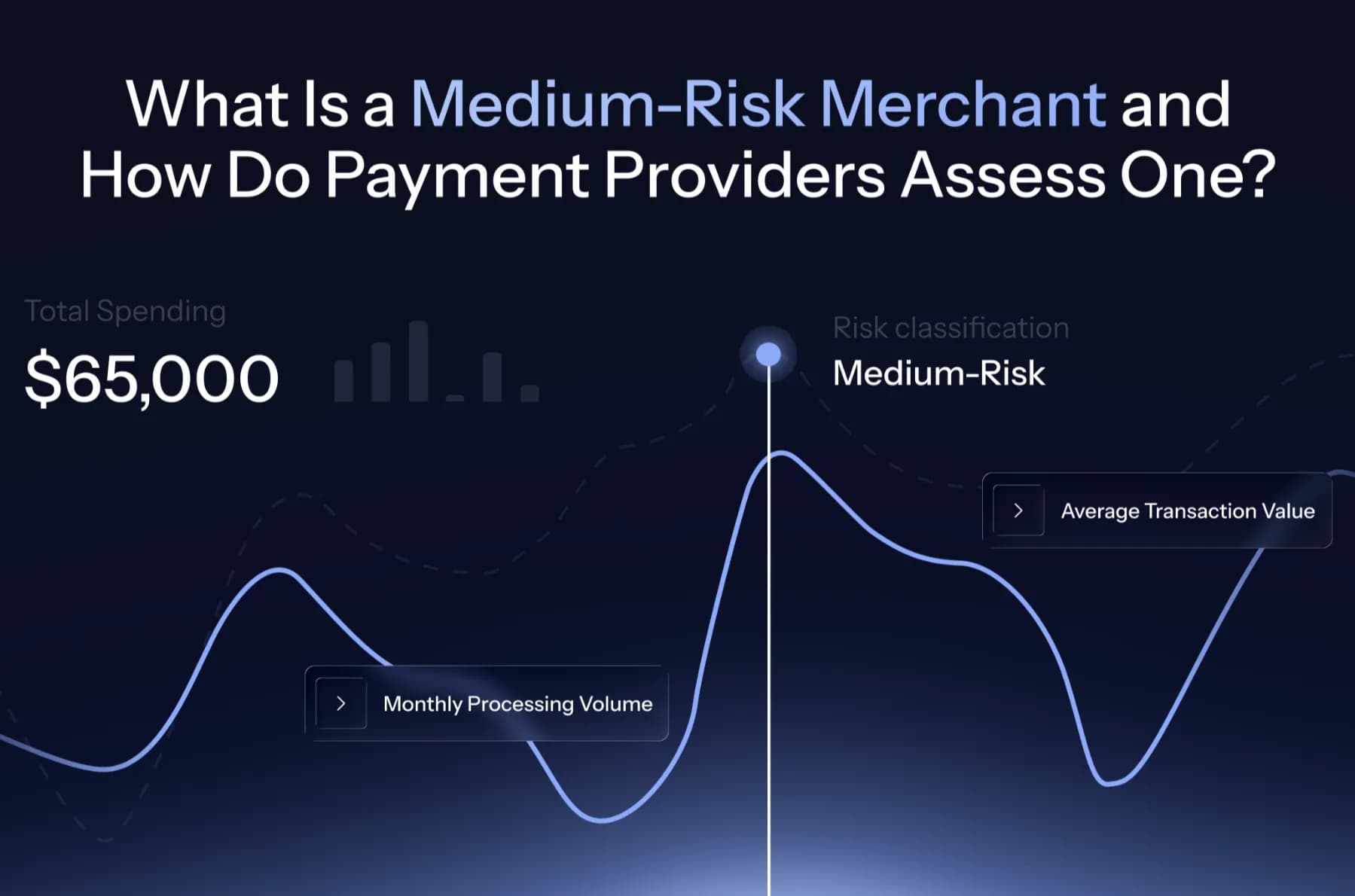
What Is a Medium-Risk Merchant and How Do Payment Providers Assess One?
A medium-risk merchant is a business that is neither low risk nor high risk, but has a medium risk profile.
We are now living in the time of agentic payments. There is a lot of confusion around AI in payments, and what AI agents in payments actually are, but this article will help clear that up. Agentic payments essentially reflect the paradigm shift from static operations to the use of autonomous AI systems in payments, which promise to elevate these systems and how we make payments within society. Payment routing automation is now increasingly possible with technical achievements, helping payment ambitions become reality. A critical inflection point has been breached which will change how financial workflows operate, with agentic AI now a must-have and not a nice-to-have in payments.
The payments industry is moving towards a complete autonomy of transaction processes, reflecting how the wider world has changed. And just in time, too. We live in an era of instant gratification with nearly every aspect of daily life drastically modernised through the use of technology. This means that consumers and businesses alike now demand greater speed, choice and transparency with their payments.
Satisfying these demands is easier said than done, especially for a payments industry still largely operating via the same underlying infrastructure its relied on for several decades. A lot of investment and resources are thrown at these networks but this fails to tackle the source of the problem. For decades, legacy fintech has been defined by "execution" with the mechanical and often brittle movement of data between disparate databases depending on a myriad middleware connections. Such legacy models suffer from "weak financial domain modelling" and a reliance on what the industry calls "pooling accounts" a term that is little more than operational slang for an architecturally immature lack of segregation. In many ways the components have always been there, but there’s been a lack of connection between these.
This is why we created the Teido Financial Operating System (TFOS) - a fundamental departure from middleware-oriented design. TFOS is a ledger-first, AI-native infrastructure that unifies issuing, acquiring, treasury, and compliance into a singular, sovereign core. This allows for multi-agent payment orchestration, with the use of AI agents to bring order and greater efficiency to these payments.
For the uninitiated, AI agents are a departure from large language models or LLMs. The latter have captured the public’s imagination around AI but this technology is fundamentally unsuited for the high-precision requirements of regulated financial services. LLMs operate in a vacuum whereas AI agents collaborate with one another, which is a critical change when it comes to their use in payments. LLMs work great in isolation, but – as covered – the issue with payment technology is its fragmented nature. This creates the need for an additional AI layer to bring sense to chaos. The TFOS system specifically uses a nervous system approach, where everything is coordinated against a scalable backbone in the Kafka platform as part of an autonomous decision-making framework.
To better understand how Teido AI is transforming the way in which payment orchestration works, it’s work taking a closer look at some core use cases.
Payment routing automation is a primary area of modernisation. Currently, traditional routing of payments is often static and operates in a vacuum with an absence of issuer-side performance – providers are therefore flying blind. Teido agents instead approach routing with greater intelligence to dynamically select the optimal path for each transaction. Dead ends are instantly identified and avoided, as are less-than-optimal routes. Real-time analysis allows these agents to instantly calculate how likely a given route to transaction is to be authorised.
Adaptive AI also enables continuous learning systems, with self-improving agents able to intelligently adapt to consumer and merchant behaviour. The benefits of this are dual – solutions are better customised, while fraudulent activity becomes easier to identify and flag.
Such an approach also enhances reconciliation, making it automatic and continuous. Legacy reconciliation solutions usually take a day or two of processing post-transaction and will involve the manual comparison of bank statements and files. This is obviously an issue for use cases such as real-time trade execution and algorithmic trading. TFOS agents, however, never stop working and perform such tasks in real-time, enabling the 1:1 valuation of issued e-money against safeguarded funds. Any discrepancies won’t be allowed to fester and instead are immediately flagged up.
This kind of insight is hugely valuable and can take treasury and liquidity forecasting to the next level. Liquidity management is a key function, ensuring there is enough capital to move around and satisfy instant requirements. This kind of simultaneous payments, across multiple jurisdictions and currencies, can be incredibly challenging for human-only teams. One of TFOS’s specialised agents, Athena, has been developed as a treasury intelligence expert. The Teido agent monitors global liquidity gaps and FX exposure to provide real-time "Treasury Health Scoring" and assist with regulatory requirements. This allows the treasury team to move from reactive management to a predictive, intelligence-led model.
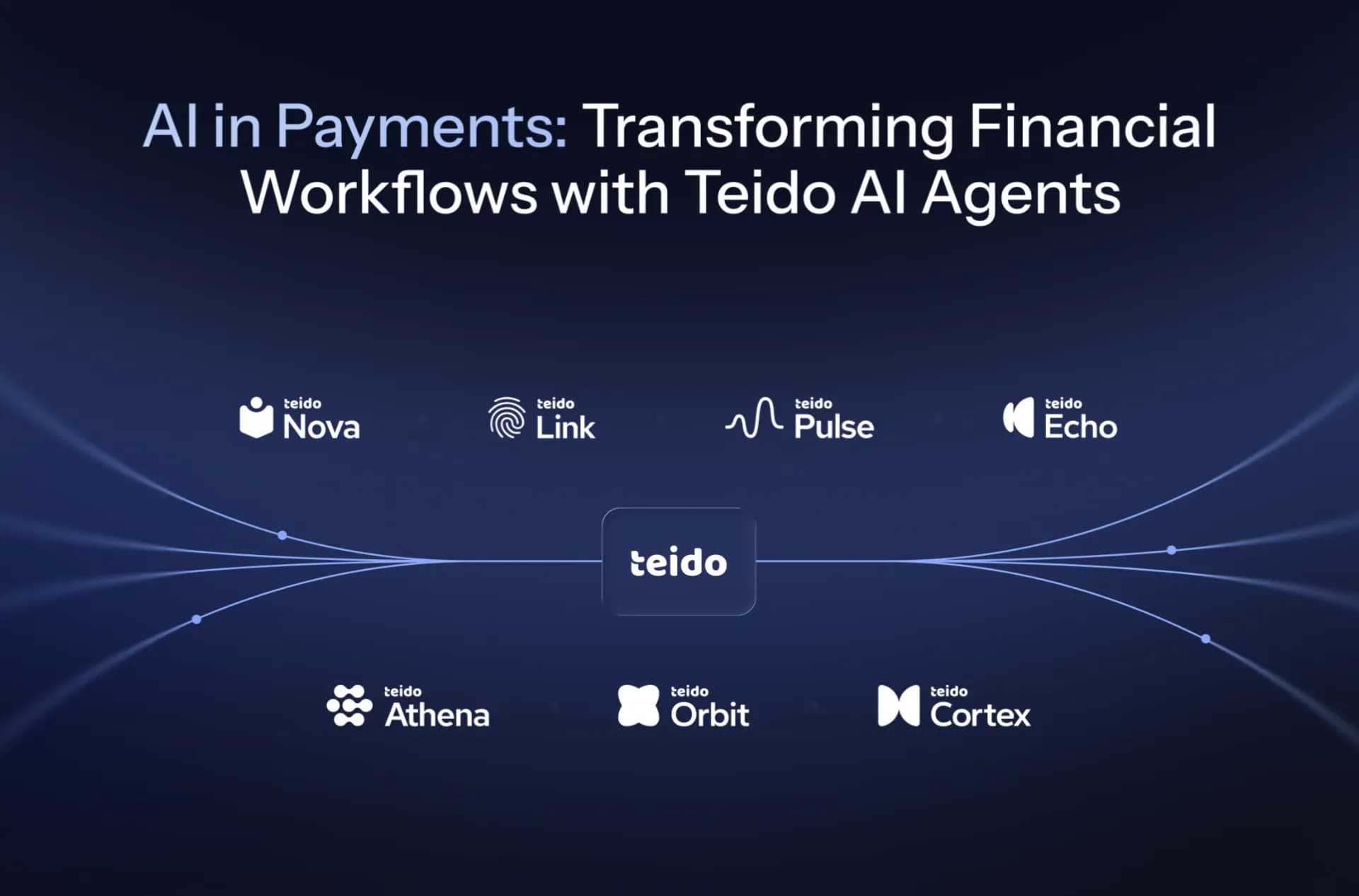
Athena is just one AI agent that TFOS uses. To establish greater overall coordination, and in the spirit of stepping away from the limitations of LLMs, Teido has developed a whole range of intelligent agents to help develop a holistic architecture. This is built around supervisor agents and highly specialised agents – as the names suggest the latter focus on particular tasks, reporting to the former that makes the most of this information and executes the orchestration.
The Teido agent ecosystem comprises:
Teido Nova: The intelligence gateway for onboarding. Nova orchestrates identity intelligence by ingesting data from external plug-ins. It generates comprehensive KYC/KYB reports and validates identity through the PrideID trust layer.
Teido Orbit: The sentinel of the transaction stream. Specialising in real-time transaction monitoring, Orbit utilises plug-ins to detect suspicious activity, mules, and behavioural anomalies across fiat and crypto rails.
Teido Cortex: The investigative specialist for complex case management, Cortex maps hidden relationships between high-risk actors, providing investigators with AI-generated narratives and link-analysis visualisations.
Teido Echo: The orchestrator of external communication. Echo automates support and operational intelligence, synchronising directly with CRMs to ensure customer interactions are grounded in real-time financial state data.
Teido Link: The guardian of reputation and fraud intelligence, Link maintains a multi-layered behavioural trust map to score the reputation of every actor within the ecosystem.
AI adoption is not without its challenges but fortunately TFOS solutions are designed to help overcome these. A major issue some find with AI is the risk of hallucinations, but these predominantly happen with LLMs. As discussed, these kinds of models work in isolation and there is often little context offered to verify or correct mistakes. As this could lead to significant issues in financial services solutions, TFOS mitigates this through a "Prompt Governance" framework and the use of Retrieval-Augmented Generation. TFOS AI solutions are grounded in verified financial data stored in our vector databases, meaning we ensure that every agent's output is based on absolute truth rather than probabilistic guesswork.
Regulations can also be an issue. The bar for best practice is again lifted in financial services, meaning there is little to no margin for error. Cardaq has evolved its data architecture to meet the highest standards of sovereignty and regulation. Following the decommissioning of Amazon QLDB due to its end-of-support, we have migrated our Ledger of Record to a high-performance PostgreSQL environment fronted by Redis for sub-millisecond hot-read access. This provides the transactional integrity of a relational database with the speed required for real-time AI orchestration.
Such innovations will help allow AI solutions to be better designed and to cope with the challenging world of payment processing. While it is still integral to keep a human in the loop (HITL), as there are numerous tasks that technology will fail to complete, these continuous improvements are taking payment processing into the future. And that’s before we get into the benefits of improved accuracy, operational efficiency and cost reduction which will all come through to what the user receives.
Conclusion
This is truly an exciting time to be working in payments, with AI and agentic payments taking solutions to the next level. The transition to a sovereign, AI-native core is the only viable path for businesses that move fast. By building an infrastructure where the ledger, treasury, and AI agents are unified, TFOS effectively eliminates the third-party dependency risk and moves away from then legacy issues holding back other fintech models. Our innovative architecture ensures that the financial state remains the single source of truth, governed by intelligence that is regulator-grade and human-approved.
Teido is building more than a payment gateway; with this technology we are constructing a sovereign, regulator-grade, and AI-native operating system for the future of finance. The era of "pooling accounts" and legacy middleware is over. The era of Intelligence Orchestration has begun. If you want to learn more about TFOS, and other ways Cardaq can support your organisation’s real-time payment ambitions, please contact the team today.
AUTHOR

Cardaq Team
03 September, 2026